
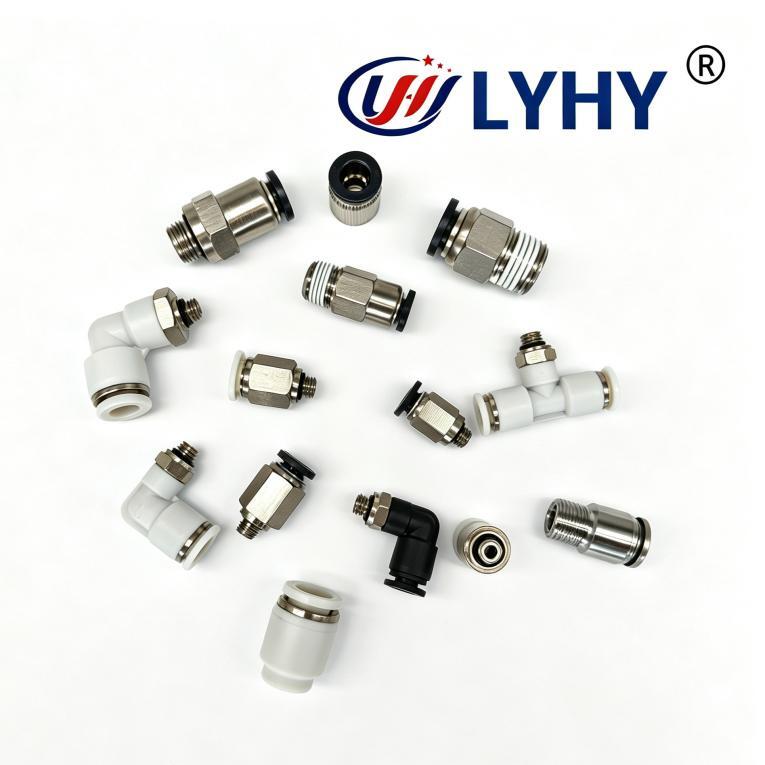
As the EU Circular Economy Action Plan (CEAP) and Eco-design for Sustainable Products Regulation (ESPR) continue to reshape industrial sustainability standards, European manufacturers are also shifting industrial product standards, from large-scale equipment optimization to component-level circularity.
The core principle of the EU’s updated circular economy framework is clear: industrial sustainability no longer relies on end-of-line waste disposal, but on designing longer-lasting, reusable, and low-wear components that keep materials in circulation for maximum life-cycles.
Why Traditional Mini Fittings Break Circular Economy Rules
Conventional mini pneumatic fittings are engineered for low-cost single-cycle use rather than long-term circulation. Under high-frequency cycling, frequent line reconfiguration and clean-room operating conditions, standard plastic and basic brass fittings suffer from seal aging, thread wear and connection deformation, leading to lose sealing performance and structural stability, forcing manufacturers to discard entire batches and purchase new replacements.
How High-Durability Mini Fittings Enable Full Life–cycle Circularity
Unlike ordinary disposable alternatives, upgraded high-durability mini pneumatic fittings embed durability, reusability and recyclability into core product design.
- Extendingservice life to cut industrial waste
Constructed with corrosion-resistant stainless steel and reinforced polymers, paired with wear-optimized seals, these fittings deliver up to three times longer service life than standard market models. Longer replacement cycles rapidly reduce annual component scrap volume, helping factories hit EU 2030 industrial waste reduction targets with verifiable performance data.
- Standardized design simplifies recycling
Fully conform to EU REACH and industrial material standards, the mini fittings adopt a separable structure with pure, standardized materials. This avoids mixed-material pollution and streamlines scarp sorting and recycling, supporting the bloc’s circular material utilization goals and material recovery.
- Reducingcarbon across the life–cycle sustainability
Disposable mini fittings with frequent replacement generates repeated carbon emissions from raw material processing and new part production. With long service life and reusable design, high-durability mini fittings effectively cut new component production demands, reducing full life-cycle carbon emissions, helping European manufacturers meet CSRD climate disclosure and EU carbon neutrality requirements.
A Small Component, A Material Contribution to EU Circular Goals
The EU Circular Economy Action Plan recognizes that the industrial transition to circularity depends not only on large-scale system changes, but also on improving the circular performance of every component in the production ecosystem. Mini pneumatic fittings may be small parts, but their ubiquity in precision automation means their circular performance adds up to significant waste reduction, resource savings and compliance value across European manufacturing.

